

Written by Nancy Lydia Kimmel RN, MSN, FNP-BC, Year III Medical School

The N.T.A. Specializes in Training Telemetry Technicians
The National Telemetry Association focuses on helping medical professionals and aspiring telemetry technicians expand their skills in the field of telemetry by providing online, self-paced telemetry training courses with nationally and internationally recognized certifications since 2010.
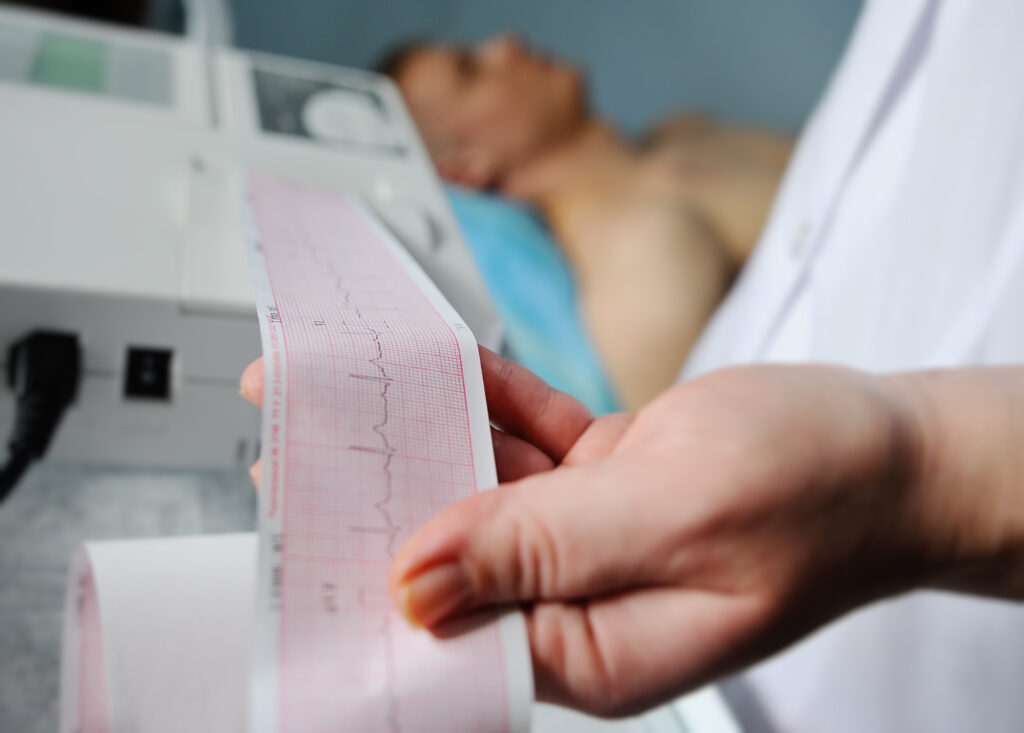
For those who may have happened upon this article, you may be wondering what exactly a Telemetry Technician does. The telemetry technician is a very important person who sits and watches your loved ones cardiac monitors day and night. The telemetry technician carefully and diligently watches each patients cardiac monitor to see if there are any abnormalities and then contact the nurse of physician immediately.
Basically, the telemetry technician saves lives daily.
You may not see them or even notice that they are in the background watching your loved ones monitors, but take heart, they are there.
So let’s take a deeper look at what a telemetry technicians job entails. Imagine a dark room filled with monitors with glowing green heart rhythms on a black background. It is not unlike waling into a Television station. There are no lights to speak of other than the light emanating from the monitors. There may be 20 monitors in one room with 5 patients rhythms per monitor. If you do the math, that would be fifty patients to just one telemetry technician.
Now if you are thinking what I am thinking, that’s a lot of patients rhythms for only one telemetry technician to watch over the course of an 8 to 12 hour shift. Right? Well, the truth is that the amount of patients per telemetry technician varies from hospital to hospital. There is no standard set for how many patients monitors one telemetry technician can safely watch.
Some hospitals may have only 10 patients per monitor technician.
While the number of patients to telemetry technician varies, the knowledge base of the telemetry technician must remain solid.
The National Telemetry Association specializes in training telemetry technicians to be proficient in the reading and interpreting of cardiac dysrhythmias and understanding how to recognize scenarios in which the patients vital signs are affected.
The National Telemetry Associations Telemetry Technician Course usually take about 8 weeks to complete. In that time the student will learn to recognize a multitude of cardiac dysrhythmias and understand how these dysrhythmias affect patients heart rate, respiration, oxygen saturation and blood pressure. Students of the N.T.A. will also need to learn about specialty medications that are used regularly in those with cardiac problems, such as Digoxin, Beta-Blockers, Alpha-Blockers, Calcium Channel Blockers and diuretics. The N.T.A. stresses to every student that the most important concept to remember is that the monitors that they are watching are not just monitors but patients, people lives and loved ones of others. The N.T.A. believes that the more knowledge a telemetry technician has, the better that they will be at recognizing dangerous rhythms and prevent patients conditions from deteriorating
A good telemetry technician will be able to catch the changes in the patient’s vitals signs immediately as opposed to telemetry technician who do not have the standardized requisite knowledge that is required in order to critically think through various situations.
Let’s look at an example. The rhythm below is what is called a normal sinus rhythm.

A patient’s rhythm can go from the above normal sinus rhythm to the one below, which is Sinus Bradycardia (or a slow heart rate)
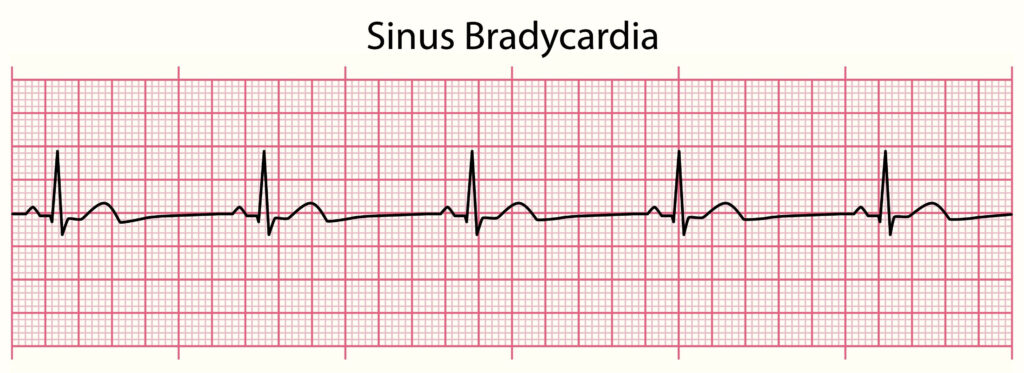
This rhythm displays a heart rate of around 48 beats per minute. While this alone may not prompt the telemetry technician to call for help, although they should, look what else might be happening to their vital signs.
Patient’s : BP 128/80 after 10 minutes patient’s BP 109/60
Patient’s : O2 Saturation initially during Normal Sinus Rhythm 96%–Then after 10 minutes 92%
Patients respiration: 15 breaths per minute – then after 10 minutes 9 breaths per minute.
While a patient’s respiration is not displayed on a telemetry monitor, the telemetry technician should be able to put 2 and 2 together if they see the patients oxygen saturation dropping. For instance, if the patient was struggling to consciously breath, then their heart rate would most likely go up.
While this scenario can imply different pathologies, the telemetry technician should be aware that the heart rate and rhythms does not occur in a vacuum, but is a result of physiology gone awry.
So how does a telemetry learn about the different pathologies of cardiac disease? This topic is covered in depth in the N.T.A. telemetry technician course. It is also to the dismay of many current telemetry technician who have not learned this and feel that all they have to do is to pass the exam to achieve their certification.
Some of the pathophysiology that is taught in the N.T.A. Telemetry Technician Course include but is not limited to the following: Congestive heart failure and the signs and symptoms, hypertrophic cardiomyopathy, both the genetic form in young adults and the condition occurring in the elderly via concentric remolding, (although in HOCM, the remolding is not even but occurs mainly in the septum blocking the aortic semi lunar valve.
Students will also learn about the development of atherosclerotic plaque, the progression to a myocardial infarction, ST Elevation Myocardial Infarction, Cardiac Arrest, valvular disease caused by Rheumatic fever, SLE, and various immunological conditions as well as chemotherapy effects along with radiation. They will learn about neonatal heart disorders, both cyanotic and non cyanotic.
Students will learn about the etiology of atrial fibrillation, atrial flutter as well as Torsade’s de Pointes. The course will cover the physiology of the heart, the actin/ myosin binding, electrical nodal system and the disorders associated with each of these anatomic sites. Students will learn about the interventions associated with a MI, V-Fib and V-Tach, A-Fib and A-Flutter. They will learn about pacemaker rhythms, the reason why pacemakers are inserted. They will learn about cardiac ablation, and Wolff Parkinson White disorder. Students will learn how to recognize junctional rhythms, premature atrial/ventricular contractions, left and right bundle branch blocks.
Students will learn how to calculate the cardiac axis and determine normal, right axis or left axis deviation and the implications of each. They will learn about pressure volume loops and how to recognize cardiac volume overload, decrease in pressure or force, i.e. preload and afterload and how this affects the patient.
This is a very comprehensive program. The N.T.A. brings this program to all aspiring students and hospital staff to promote an increase in patient safety, faster recovery time and minimize sentinel events.
Each of the modules and learning units are based on academic literature and articles with meta-analysis when applicable, and cited references.